Erin, a College Junior, Shares Her Perspective
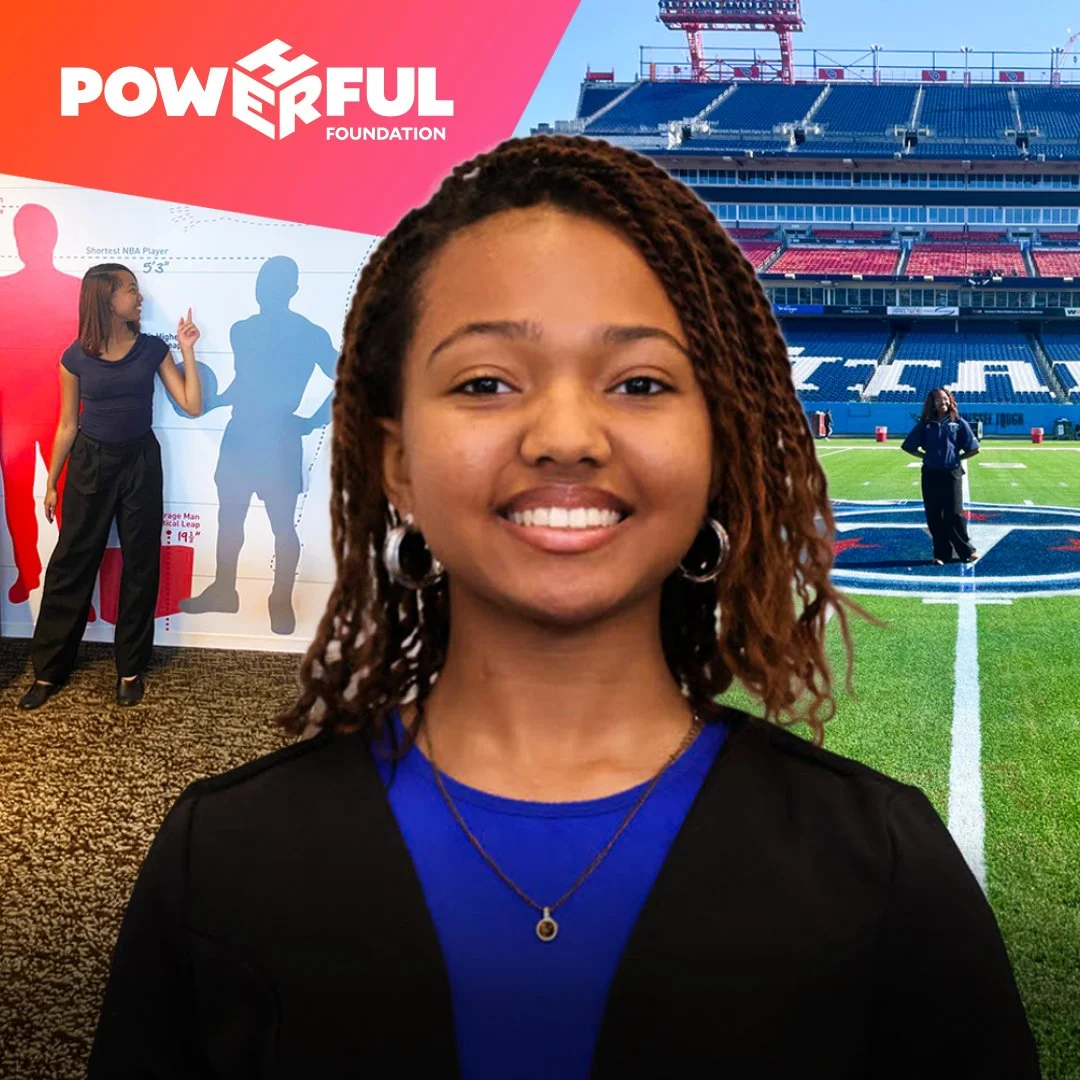
Already fully immersed in the fall semester at Howard University in Washington, D.C., PowHERful scholar Erin Fitzgerald admits to being both excited and anxious. With two years of college behind her, an award-winning student with a grade point average nearing 4.0 and a clear idea of her academic and career direction, Erin would seem to have it all under control. But that’s not how she sees it. Thoughtful, self-reflective, at times self-deprecating, Erin knows she still has plenty to learn—academically, yes, but also socially and, especially, about herself. This is so much of what college is about.
HOW I FOUND MY DIRECTION
“I was in high school during COVID-19, when I began to watch sports more frequently,” Erin says. “It was one thing I really enjoyed. That made me wonder whether this interest in sports could lead to a career. In my senior year of high school, I became a reporter for my school’s sports show. I got a lot out of it and did quite well—I was named English Student of the Year.
“Thinking about college at that time, I was hesitating between studying Law, Business, Communications, or Journalism. When I began to research Sports Management, it looked like a perfect blend of all of it. I want a career that avoids repetitive work, one with movement and purpose. Sports Management looks like a really good fit.”
Once in college, Erin found that her courses confirmed her interests. It suits her temperament. “I’m detail-oriented, but I’m also a dreamer. I like to explore beyond what’s expected and imagine what a project might become in a strategic, even grandiose way. I think these tendencies will serve me well where creativity in sports marketing is concerned, in branding, merchandising, and activations.” Erin is idealistic as well, which becomes apparent when she describes a new, specific job interest. “I’d especially like to work as a Community Relations Specialist for a professional sports organization as a way to engage meaningfully with communities, to provide something tangible for them using sports as a vehicle for change.”
SOCIALIZING AND SELF-ACCEPTANCE
“As a freshman, I pushed myself to do things I wasn’t used to doing,” Erin told us. “I met nice people. I took advice from college students on TikTok and introduced myself to my professors, went to office hours, and stayed active in my classes. And I took the time to embrace D.C., take the metro, go to museums, do some gig work. All of this was really positive.
“But everyone says, ‘These will be the best four years of your life, you’ll meet your future bridesmaids, your children’s godparents, etc.’ Well, two years have gone by, and that’s not been my experience—and not for lack of trying. At first, I put too much pressure on myself to find my ‘forever friends.’ I didn’t enjoy my first two years of college as much as I might have because I feared and worried about forging friendships. I wasn’t meeting some arbitrary standards I’d set for myself.
“Over time, I’ve learned how important it is to relax and be myself, rather than fitting myself into a mold to be what I deem others would find acceptable. I’m starting to feel better about being shy and I’m giving myself more time to be alone. I see it as a way of getting to know myself better. And I have a better sense of what I like and don’t like. I can see people's behaviors more clearly, and I can better assess who I want to be friends with. I find I’m advocating for myself more, and I spend more time thinking. I feel more like an adult.
“Going forward—and this might sound counterintuitive—I want to work hard and relax. I know now how important it is to take breaks. During Finals Week my freshman year, I pushed myself too hard and completely burned myself out. I never want to experience that again. This year, I really want to focus my energy on positives, and not mull or sulk over what-ifs.”
A CRISIS, AND A POWHERFUL SCHOLARSHIP
Late into her sophomore year, Erin thought her college ambitions might end, then and there. The school’s financial office told her she had to make an emergency payment for student housing and tuition or, no exceptions, she’d lose her place at Howard—the college she’d worked so hard to get into. She was at her lowest knowing that, at this moment, her options were all but exhausted.
When she’d applied to colleges, Erin had learned that local and regional scholarships existed to help college students who needed financial help. She’d researched and applied to as many as she could, and was well rewarded for it. These modest scholarships had helped—but they hadn’t been enough to protect her from this moment, when her expenses had peaked. Now, Erin didn’t have time to research, apply, wait, and hope. This was an emergency. But Erin was not ready to give up. She remembered reading about PowHERful, a foundation focused on helping young women get through college. She decided to reach out. This was an excellent decision, as PowHERful responded directly. Recognizing Erin’s abilities and drive, the foundation awarded a substantial scholarship in response to the emergency, providing the means and support she needed to continue her semester’s coursework and enter her junior year with renewed peace of mind.
WORK AS HANDS-ON LEARNING
While Erin had applied for and received Federal Work-Study, she says she encountered some hiccups along the way and ended up earning less than was awarded in her aid package. Nonetheless, she’s grateful for the work experience she did get, and to the people she worked with. “I’ve looked for a part-time position for this academic year, but no luck. I do have a gig job working for a game card company called Bestie Banter. And I’m working as a stadium and operations event intern for the Washington Commanders.
“Working helps put my studies into perspective. Managing jobs while taking classes has pushed me to grow. I’ve learned how to set my priorities and plan ahead. Yes, sometimes a job gets in the way of studying or schoolwork, but I want to learn how to balance everything. Life isn’t going to get any easier.”
THE AI CONUNDRUM
Erin thinks back to an AI-related experience in high school that had a dramatic effect on her. “I was in a dual enrollment program, where I could take college-level courses and earn credit towards my high school program and a college degree at the same time. My first assignment in an English class came back with a low grade—the professor had flagged me for plagiarism. She left a comment on my work saying I needed to meet with her and that I risked being expelled from the program. I was so upset and afraid. It was really dramatic. As it turns out, the professor used a faulty AI program to screen my work. Once the problem was fixed, all the red flags on my work disappeared.
“From then on, I promised myself I’d never use AI generation for writing assignments—I never will, for as long as I live. I decided to become a better writer on my own. Since then, I’ve noticed that students who use AI to generate papers or complete assignments seem to pick up the AI style to the degree that, even when they write a paper entirely from scratch, they take on an AI voice. I want to avoid this at all costs.
“In college, professors seem to be split on whether AI should be used or not. Some are fine with students using AI for assignments, as long as they note they’ve used it. Others completely ban it. I actually prefer when professors ban AI; I find they emphasize more personal connection in class.
“Looking forward, I’m hoping the sports industry continues to thrive despite AI. When I checked freshman year, the sector was projected to grow. Now, frankly, I’m a bit scared to look, given how AI has infiltrated marketing and communications. It seems so many people and companies are fine with AI use by public relations specialists, writers, social media liaisons, etc. I hope they come to their senses. It seems to me that AI makes many of the same mistakes as humans, but is more willing to pass them on as truth.
“I do still feel confident in finding a role in my chosen field post-graduation; there has been exponential growth in women’s sports, notably basketball and flag football. I hope this trend continues, and that there will be a multitude of jobs in my area of interest—in brand activations, in community engagement, and in marketing for a professional sports organization.”
MANAGING ANXIETIES
Despite appearances, Erin continues to deal with anxiety. She tells us, with a wry smile, that she’s anxious about “everything—present, future, and past. I worry about mistakes, being a failure, not having the future I want, and not even being able to have a future because of all that’s going on politically and with climate change. I talk with my best friend, and she helps a lot, but I don’t like to burden her. And I’ll talk to my mother about my concerns, but the subject eventually changes and I’ll be told to find religious peace. But I feel I need to approach these issues logically. I know they can’t be fixed with a simple bandage; it will take a lot of time and effort.” These days, Erin finds it therapeutic to write and record videos of herself voicing her concerns. “Eventually, I’m going to talk about these issues online, through a Substack or a YouTube channel, to articulate them more clearly and connect in a calm environment with like-minded individuals.”
WHAT KEEPS ME GOING
“History, faith, and justice keep me going,” Erin says. “When I think of my grandmother and grandfather working on plantations in Mississippi and Arkansas, it reminds me my education is not just for me—it’s for everyone who worked so hard for me to be able to go to college. It would be a disservice to myself and to them not to push myself as far and as high as I can go… It wasn’t that long ago that the thought of a Black woman in a classroom past the 6th grade was practically unheard of. Change doesn’t happen without sticking with it. I’m determined to keep working hard so that, one day, my grandparents can enjoy a comfortable retirement. They’re kind and humble and don’t want for much, but I’d like to make a meaningful contribution so they can live the life they’d like, peacefully and at home.
For her junior and senior years, Erin has goals beyond doing well academically. She’d like to continue to gain more experience in tasks and leadership roles for on-campus clubs like the TN Club, Minorities in Sports, Spotlight Network, and the National Council of Negro Women. Outside of school, she’s hoping to contribute more to communities both at home in Memphis, TN, and in the DMV (or Washington, DC) metropolitan area. In addition, “I’m hoping to have internships over the next two years to have a great start to my professional career. I’d especially like to gain work experience in sports media, as this is the area I love most.”
Erin continues to plan and to nurture her hopes while maintaining a healthy perspective. “I like to plan in advance, but I try to keep my goals relatively broad to decrease the pressure I put on myself. At the same time, I don’t want my goals to be so broad that I lose sight of the steps I need to take to achieve them. I’m learning to take the no’s with the yes’s, and I know I may not always get what I want. If I don’t, I’ll know at least I tried. I keep reminding myself: just live and learn.”
Image credit: PowHERful / Erin Fitzgerald